Sunday, December 2, 2012

A Secret Recipe


Malaysian Farm. Pic by Shloke
There’s no alarm clock as we’ll never need one. As the sun is rising up it was time the roosters woke me up while coldness went through my skin and struck me up. But, I never got up. It’s been two days since I live with my grandma. Never get any better feelings than these. No school. No big cities. No traffic congestions. No waking up early. No my mum’s blabbering. In countryside, every single thing seems to be perfect. Perfect captivating panorama. Perfect calming weather. Perfect farming activities. Perfect orchard with juicy seasonal fruits. Perfect friendliness. And most importantly, perfect grandma’s cooking. Besides running a farm and orchard, she does caterings for weddings as she is no doubt a great cook.


Nasi Lemak. Pic by A Season with Spice
         There’s a lot of customer asked her for the secret recipes. Secret recipes? I have seen her cooking for my entire life. There is no so called secret recipe.  She delicately cooks, with love. Every single aspect that is considered crucial, she’ll never miss it: cleanliness during food preparation, healthy ingredients, fresh meats, and complete sets of South South East Asian spices. You will never get even one meal as nicely cooked as hers back in Kuala Lumpur (Capital of Malaysia, where I did my freshman and junior years). All is ‘normal’. All is machines. All have to be fast, and all is freaking expensive. I still remember vividly when my date brought me to a ‘food court’ (where usually foods sold are cheap in Malaysia) in Petronas Twin Tower (used to be the highest tower in the world, now still the highest twin tower). A plate of Nasi Lemak could cost MYR 20.00 (USD 9.00) which would only cost MYR 4.00 (USD 1.00) if purchased at ‘lame’ mamak (migrated Indians that sell both Malaysian and Indian food) stalls.

Having a very hard life in Kuala Lumpur, I had to be frugal and be careful of what I’m purchasing. I’m no super rich kid. 
Food Court in Petronas Twin Tower. Pic by Raja Nong

Malaysian Mamak Stall. Pic by Raja Nong
            I learned how to cook the hard way. Setting up my own kitchen in my apartment in Kuala Lumpur, I was at first crawling and slowly pick up my grandma’s secret recipes of cooking. From traditional to modern cuisines, I am now a master. My most favorite meal is Rendang. A very traditional Malaysian and Indonesian cooking, Rendang has been continuously ranked as top 15 best foods in the world. With tasty textures and great smells, it too has been my all-time favorite. During my first trial I already managed to produce Rendang that is so close to what my grandma always cooks. My second trial, it was a masterpiece, I am as master as my grandma, I have become a grandmaster. It breaks all the questions down whether or not there is a secret recipe and whether or not it is easier to prepare. Whether it contains Secret recipe or not, Rendang is indeed one of the easiest Asian meals to prepare. Even a cooking newbie like me, could produce a masterpiece after two trials, why can’t you? You can actually enjoy something better and cheaper than those at mamak stalls if you know how to cook rendang using some Asian ingredients and spices. 
 
However, you might ask is the taste the only thing that is concerned over here. As the spices are the major things that give rendang the awesome taste, it is better to have a closer look of all the spices. What are the goodness those spices bring you? Although it is very hard to find an article that just talks about the goodness of it, we can still somehow look at the goodness of each of the ingredient and among the main spices are: cinnamon, star anise, cloves, lemon grass and cardamom.

Spice
Goodness

  •    Cancer Prevention
  •     Anti-Clotting
  •     Arthritis Relief
  •   Anti-Bacterial
  •    Brain Health

  •  Relieve digestive ailments
  • Improve appetite

  • Get rid of bad breath, or sore throat
  • Cloves have natural anesthetic properties (due to the eugenol oil in it)
  • They also have antispasmodic qualities, applying it topically relieves muscle spasms

  •  Promotes a restful night of sleep
  • To relieve nausea and is an aid in digestion
  •  To keep the kidneys and bladder working properly

  • Improving digestion
  • It is a good stimulant and beneficial for those suffering from flatulence and gas.
  • Cleansing the body as it has detoxifying properties
  • It improves blood circulation to the lungs and can be helpful in prevention of spasms or convulsions
Table above shows spices used in rendang together with their goodness

            It is interesting to see how a meal could have a lot of spices that bring goodness to you. It is like a package of healthiness and great taste. However here in the US, Malaysian like me crave for this type of food every day and even American that want to try this great food find it is not easy to obtain rendang. Fortunately, I am hereto show you how to cook rendang for those who want to try to cook it.
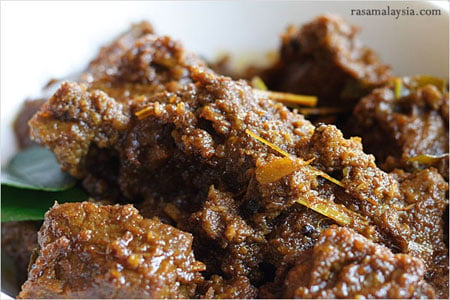
Beef Rendang. Pic by Rasa Malaysia (Malaysian Taste)

Recipe: Beef Rendang (Rendang Daging) or Spicy Beef Stew with Coconut

Ingredients:
1 1/2 pound boneless beef short ribs (cut into cubes)
5 tablespoons cooking oil
1 cinnamon stick (about 2-inch long)
3 cloves
3 star anise
3 cardamom pods
1 lemongrass (cut into 4-inch length and pounded)
1 cup thick coconut milk
1 cup water
2 teaspoons tamarind pulp (soaked in some warm water for the juice and discard the seeds )
6 kaffir lime leaves (very finely sliced)
6 tablespoons kerisik (toasted coconut)
1 tablespoon sugar/palm sugar or to taste
Salt to taste

Spice Paste:
5 shallots
1 inch galangal
3 lemongrass (white part only)
5 cloves garlic
1 inch ginger
10-12 dried chilies (soaked in warm water and seeded)

Method:
  1. Chop the spice paste ingredients and then blend it in a food processor until fine.
  2. Heat the oil in a stew pot, add the spice paste, cinnamon, cloves, star anise, and cardamom and stir-fry them until aromatic.
  3. Add the beef and the pounded lemongrass and stir for 1 minute.
  4. Add the coconut milk, tamarind juice, water, and simmer on medium heat, stirring frequently until the meat is almost cooked.
  5. Add the kaffir lime leaves, kerisik (toasted coconut), sugar/palm sugar, stirring to blend well with the meat.
  6. Lower the heat to low, cover the lid, and simmer for 1 – 1 1/2 hours or until the meat is really tender and the gravy has dried up.
  7. Add salt to taste. If not sweet enough, add more sugar to taste.
  8. Serve immediately with steamed rice and save some for overnight.
Cook’s Notes:

Before
  1. To prepare the kerisik or toasted coconut, just add the grated coconut to a dry wok and stir continuosly until they turn golden brown.

After

And for those that find it is hard to follow the recipe listed above, I attached videos, showing step by step on how to cook rendang.


The hardest part to cook rendang is to prepare all the ingredients. Once you have the ingredients, you are ready to go.  For all readers that are currently in Malaysia, it is advisable to cook your own rendang at home. And for readers that are not in Malaysia, whether you are Malaysian or someone who just want to try this delicious Malaysian food, you can cook your own rendang in 6 simple steps. Cooking your own rendang you can definitely save a lot of money, know what are inside your meals, and you yourself will determine the cleanliness level during preparation. Besides having one of the greatest meal in the world, you will gain the goodness from the spices. Although making rendang needs a lot of time, you have a lot of fun experimenting and breaking down the so called “secret recipe”.


P/S: Any question of how to cook rendang or any other Malaysian meals, feel free to email me at wilyas92@gmail.com. I would love to help you.


Saturday, December 1, 2012

“Beauty is in the Eye of Another” “What’s Eating You” –Food for Thought
Food is essential to life itself. Every living organism needs food in order to survive. The kind of food that’s consumed is the issue. As people we have the right to chose what we eat and when we eat it.
When we eat we don’t think of the outcome of our consumption choices. Sometimes we don’t even think about how much we consume. The only thing we do think about is fulfilling the urge we have to eat. Doctors encourage us to eat healthy and exercise daily in order to fulfill a healthy lifestyle. Although it’s easy to agree to eat healthier it is harder to actually do it. Theories of Hunger and Eating Behaviors can explain why it is hard for us to maintain a healthy diet, let alone commit to one. There’s the Drive-Reduction Theory of Hunger; which makes us feel certain drives (hunger, thirst) and then act in ways to reduce those drives (eat, drink) (Emotion & Motivation Lecture 2012). Next, is Internal-External Theory of hunger; which occurs when obese people are motivated to eat more by external cues (advertisements, smell of foods) than internal cues (biological indicators like low glucose levels) (Emotion & Motivation Lecture 2012). The Glucostatic theory can also explain why we have this natural (Biological) urge to eat, which occurs once our blood glucose levels drop and creates a drive to eat (Emotion & Motivation Lecture 2012). There are people who can eat tons of food and still maintain a specific weight, while there are also those who do the exact opposite. Their ability to do this comes from our bodies natural a set point. This is a genetically programmed set point for a person’s body fat, muscle, and metabolism to maintain this particular weight (Emotion & Motivation Lecture 2012).
Many health professionals use the body mass index scale (BMI) to quickly assess a person’s weight. The purpose of the scale is to predict a person’s body fat percentage, in hope of determining the risk of chronic diseases and whether any lifestyle changes should be done to help control weight gain. The BMI scale only takes height and weight into account, and fails to recognize age and gender. So, because of this it may not be the most accurate means of determining body fat and diagnosing obesity. For example, if you’re a body builder, chances are your body fat percentage is pretty low and your lean body mass id impressive. Since, the BMI scale only knows your weight; it probably won’t know that you train nearly every day to look that way. So due to body mass being a contributor to your weight, you’d be classified as overweight. The same goes for people with shorter legs; whim may be classified as overweight even when they are not.
The human body mass index scale is not the only thing contributing to this problem involving weight and obesity inaccuracy. The media also plays a huge role on how people view themselves and others as “Skinny, fat, healthy, overweight, and or beautiful”. Factors, such as reality TV shows, advertisements, commercials and models are the main sources of influence. They feed us what they want us to believe a person should or shouldn’t look like. The biggest problem with this is the perception that one adopts about their self and body image. The old definition of beauty seems to have been swept under the bony underbelly of the beauty and fashion industry. In its place, is an idolatry of bony and paper-thin (Sanders 2011).
So much unhappiness comes from this, because it is so hard to compare yourself to what the media perceives as perfect. I don’t believe that the media thinks about the amount of negativity they put out to help sale a product or let alone what they influence upon a person’s self-esteem. How is mere skin and bones beautiful? How does the image of a skeletal model radiate sex appeal or conjure feelings of envy in young adults? Since when was the media given the power to define what beauty looks like? (Sanders 2011). Let’s not forget that beauty is in the eye of the beholder, not the media (Sanders 2011). We feed off of tabloids, fitness magazines and buy into miracle workout programs for the wrong reasons, and look what we end up with: eating disorders, self-esteem issues and a falsified conception of beauty and normality (Sanders 2011). Being born beautiful may not always be an option, but media discretion certainly is — perhaps it’s time we start using it (Sanders 2011).
The topic I chose to write about related to me in so many ways. I do not have an eating disorder, but I have been told and influenced by other people on what I should look like and how much I should weigh. I was born premature along with my twin brother, Raymond. We were highly undeveloped in every way you could think of, from undeveloped brains, lungs and hearts. We were constantly told we were underweight, but as we got older we were constantly told we were obese. This being easier on my brother and harder on I, simply because I was a girl and I cared what people thought about me. This obstacle eventually turned into a personal battle with me. I used to want to be skinny so bad, and wear the clothes that the girls wore in the hottest magazines. I used to try to diet and sign up for work out programs until I realized what I was doing to myself. I had to realize that in order for me to be happy I had to love myself; the way I was and that no one is perfect. Today I tell myself that there’s always room for improvement , but there will never be complete perfection, because beauty is indeed in the eye of the beholder and that beholder is you.